How Simpler Social Media Could Restore Control Over Your Feed
The Social Media That Doesn’t Exist Yet
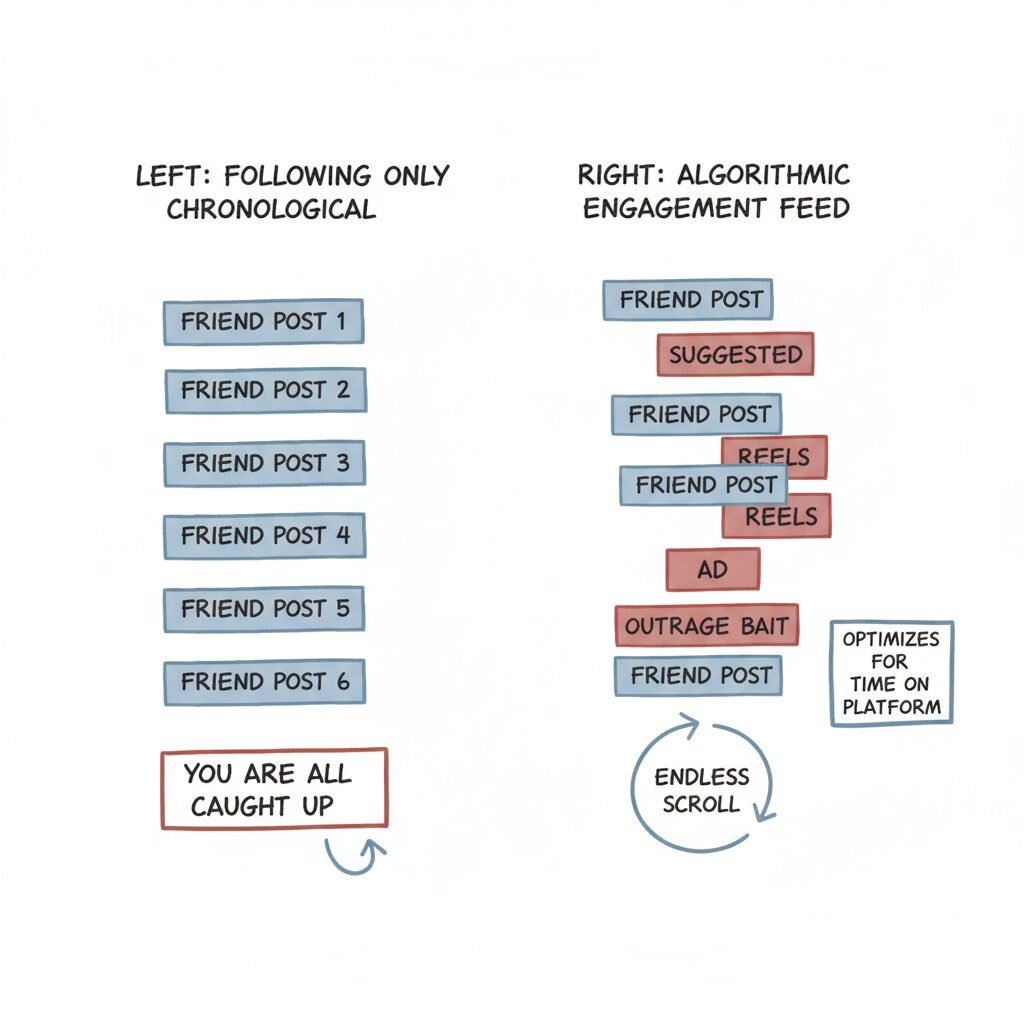
Picture opening a social app and seeing only posts from people you chose to follow. In the order they posted them. No ads wedged between photos of your cousin’s kids. No “suggested” videos from strangers. Just… what you asked for.
It sounds almost quaint, like describing a phone that only makes calls. But that simplicity points to something important about why current platforms feel so exhausting – and what a genuinely healthier alternative might require.
The Feed You Never Requested
Most people assume their social media feed shows them what their friends posted. It doesn’t.
What you see is determined by an algorithm optimizing for one thing: keeping you on the platform longer. That means prioritizing content that triggers strong reactions – outrage, envy, anxiety, fascination. Your friend’s calm photo from a hiking trip loses to a stranger’s inflammatory hot take every time.
The average social media user now sees more content from accounts they don’t follow than from people they actually chose to connect with.
This isn’t a bug. Platforms discovered that showing you what you requested creates a natural stopping point. You see your friends’ updates, you’re satisfied, you leave. But showing you an endless stream of algorithmically-selected content? That keeps you scrolling.
What “Caught Up” Used to Mean
Instagram once had a feature that seems almost radical now: a simple message saying “You’re All Caught Up” when you’d seen everything from accounts you follow.
It treated your attention as something to respect rather than capture. You finished. You could leave.
That feature has been quietly buried under layers of “suggested posts” and “reels you might like.” The concept of being finished with social media has been engineered out of existence.
The Performance Problem
Beyond algorithms, there’s another layer making social media feel heavy: visible metrics.
Likes, comments, shares, follower counts – these transform posting from sharing into performing. Every photo becomes a test. Every thought you type gets filtered through “how will this be received?”
Some early internet spaces worked differently. Blogs and forums focused on the content itself. You shared something because you wanted to share it, not because you were hoping for validation numbers.
The shift from sharing to performing happened so gradually that most people don’t remember social media ever feeling different.
Consider what posting might feel like without public metrics. You share a photo from your weekend. Maybe friends see it, maybe they don’t. No number tells you whether it was “successful.” No dopamine hit from watching likes accumulate. Just… putting something out there and moving on.
The Simplicity That Got Stripped Away
Early Facebook – before it tried to be everything for everyone – functioned more like a shared bulletin board for people who already knew each other. Chronological posts. Actual friends. A finite amount of content.
People describe that era with a specific kind of nostalgia. Not for the technology, but for the feeling. Smaller. More human. Less like shouting into a void hoping for algorithmic approval.
The same pattern appears across platforms. Every social network starts with a clear, limited purpose. Then growth demands they expand. Features multiply. Algorithms optimize. Ads infiltrate. The original experience gets buried under layers of engagement mechanics.
What if someone built the opposite?
Designing for Departure
A healthier social platform would need to break from the fundamental business model driving current ones. Advertising-based social media will always prioritize keeping you on the platform. That’s what advertisers pay for.
Some alternative approaches:
– Chronological feeds only – showing posts in the order they were made, from accounts you follow
– No public metrics – removing likes, follower counts, and engagement numbers
– Built-in endings – clear signals when you’ve seen everything new
– Follow limits – capping the number of accounts you can follow to keep feeds manageable
– No autoplay – requiring a deliberate choice to watch each video
None of these are technically difficult. They’re just incompatible with advertising-based growth.
Working With What Exists
Until that simpler platform appears, most people are stuck navigating spaces designed to capture attention rather than respect it.
One approach that addresses this directly: adding friction back into the experience. Browser extensions like MonkeyBlocker work on this principle. Its Social Cleaner feature hides algorithmically recommended content – Shorts, Reels, suggested posts – while keeping posts from accounts you actually follow visible. The feed becomes closer to what you requested instead of what the algorithm decided to show you.
For the automatic pull of checking social media repeatedly, friction-based tools insert a pause before the page loads. That brief delay gives the conscious decision-making part of your brain time to catch up with the habitual impulse. It’s not about blocking access entirely, but about creating a moment of choice where automatic behavior usually takes over.
These workarounds aren’t perfect substitutes for platforms designed differently from the start. But they acknowledge something important: the problem isn’t just willpower. It’s that current platforms are engineered to bypass deliberate choice entirely.
The Space Between Quitting and Accepting
The conversation about social media often polarizes into two camps: delete everything, or accept things as they are.
But there’s territory in between. Using platforms intentionally while recognizing they’re designed to prevent exactly that. Advocating for different design choices while working around current ones. Remembering that the exhausting, scattered feeling these apps create isn’t inevitable – it’s a choice made by people who profit from your attention.
Social media could be a place where you see what your friends are doing, feel connected, and leave when you’re done. That this sounds utopian says more about what we’ve accepted as normal than about what’s actually possible.