Why Teams Should Stop Choosing Between Speed and Quality
The False Choice Between Fast and Good
Every team has felt this tension. A deadline looms. The work isn’t quite ready. Someone pushes to ship it anyway because momentum matters. Someone else pushes back because quality matters more. Both are right. Both are wrong.
The real problem isn’t choosing between speed and quality. The real problem is treating them as opposites in the first place.
Understanding why this framing fails can change how an entire organization makes decisions. And it starts with recognizing that most business advice on this topic misses a crucial distinction.
Why “Move Fast and Break Things” Broke
The famous Silicon Valley mantra sounds bold. It promises agility, innovation, a bias toward action. But organizations that actually operate this way tend to accumulate a specific kind of debt.
Not just technical debt, though there’s plenty of that. Trust debt.
When teams ship sloppy work repeatedly, customers start hedging their bets. They keep alternatives bookmarked. They read the reviews before upgrading. They become harder to retain because they never fully committed in the first place.
The time saved by rushing gets spent on damage control, customer service escalations, and rebuilding credibility.
Meanwhile, the team burns out. Not from the pace itself, but from the chaos. Fixing the same problems repeatedly. Apologizing for preventable failures. Losing faith that leadership has a plan beyond “go faster.”
The Opposite Trap Is Just as Dangerous
Perfectionism sounds like professionalism. Taking time to get things right feels responsible.
But markets don’t wait for perfect.
While one team polishes their solution, competitors ship something adequate. Customers adopt it. Habits form. By the time the “perfect” version arrives, it faces a completely different challenge: switching costs.
Now the question isn’t whether the product is better. The question is whether it’s better enough to justify the hassle of changing. Usually, it isn’t.
Late and perfect often loses to early and good enough.
The pursuit of quality becomes its own form of recklessness when it ignores timing entirely.
The Distinction That Changes Everything
Strong operators don’t agonize over speed versus quality as a philosophical question. They treat it as a categorization problem.
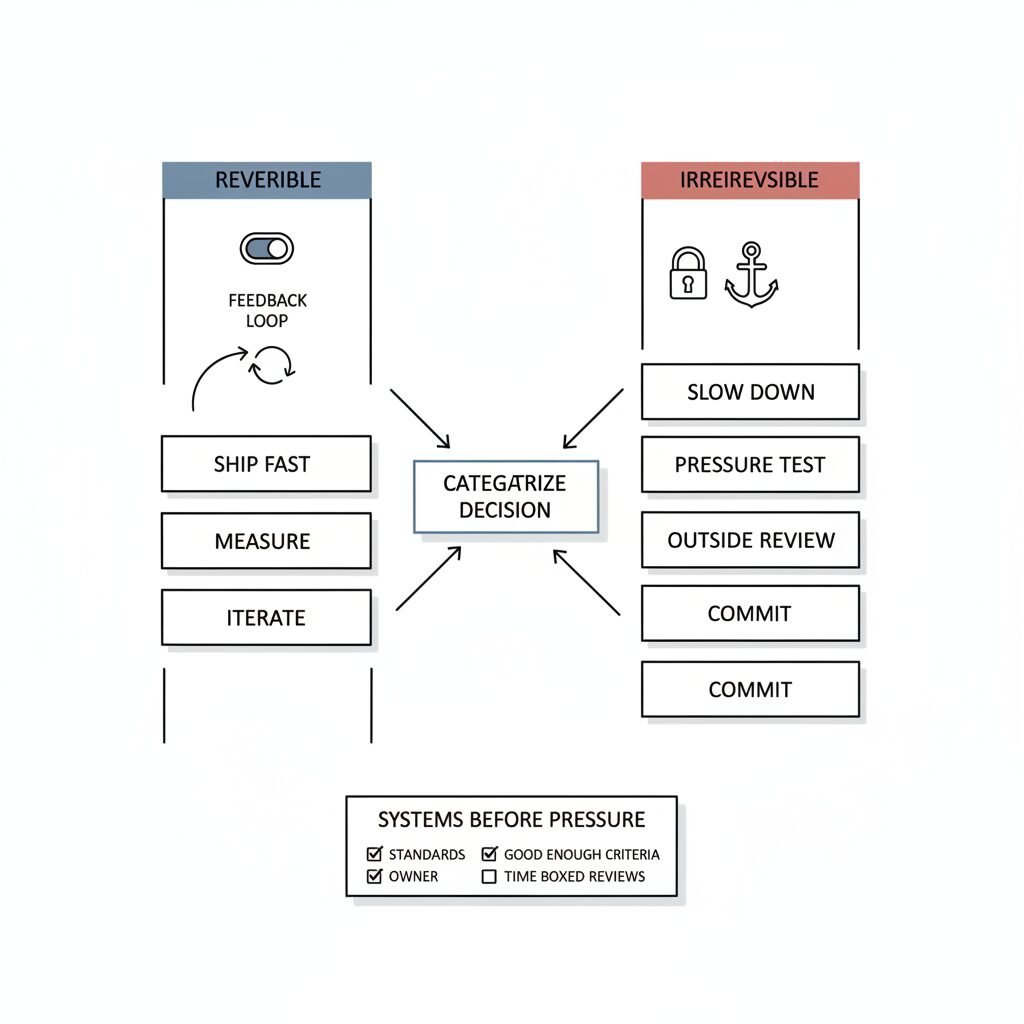
Some decisions are reversible. A pricing experiment. A landing page design. An internal process change. If it doesn’t work, you adjust. The cost of being wrong is low.
Other decisions are irreversible, or close to it. A major platform migration. A key hire. A public commitment to customers. Getting these wrong has cascading consequences that take months or years to unwind.
The skill is sorting decisions correctly.
Reversible decisions deserve speed. Ship fast, measure quickly, iterate without hesitation. The feedback loop itself is the quality control.
Irreversible decisions deserve deliberation. Slow down. Pressure-test assumptions. Get outside perspectives. The upfront investment in thinking pays dividends in avoided disasters.
Most teams fail because they don’t distinguish between the two. They treat everything as equally important, which means everything moves at the same cautious pace, or everything gets rushed equally.
Systems Beat Willpower
Telling a team to “balance speed and quality” is useless advice. It’s the business equivalent of “eat less, move more.” True in principle. Unhelpful in practice.
What works is building the decision into the process before the pressure hits.
This means:
– Defining quality standards before projects start, not during crunch time
– Creating explicit criteria for what “good enough to ship” means
– Establishing clear ownership so decisions don’t get stuck in consensus loops
– Building review checkpoints that are mandatory but time-boxed
When the system handles the judgment calls, individual willpower stops being the bottleneck.
Iteration Is the Third Option
Most people think of shipping as binary. Either you release something finished, or you release something incomplete.
But the best teams operate with a different mental model. Ship fast, then iterate. Not “ship broken,” which erodes trust. Ship functional, then improve.
This requires one key ingredient: feedback infrastructure. If you can’t measure what happens after shipping, you can’t improve it. And without improvement cycles, fast shipping is just gambling.
The goal isn’t perfection on launch day. The goal is momentum with standards. Continuous improvement beats delayed perfection every time, but only if the improvement actually happens.
When Digital Distractions Hijack the System
Here’s where this principle connects to something less obvious: the role of impulsive digital behavior in derailing execution.
Teams that struggle with the speed-quality balance often have a hidden problem. Key decisions get delayed because people are scattered. Focus fragments. The cognitive overhead of constant context-switching means that work that should take two hours takes six. By the time something ships, it’s late and still not as good as it could have been.
For individuals managing this tension, friction-based tools can help. Browser extensions like MonkeyBlocker apply the same reversible-versus-irreversible logic to digital behavior. The Impulse Check feature introduces a brief pause before distracting sites load, creating a moment for the conscious mind to participate in what would otherwise be an automatic habit. The Scroll Stopper inserts breaking points into infinite feeds, turning passive drift into deliberate choice. These aren’t complete solutions, but they reduce the cognitive tax that makes good execution harder.
The Real Measure of Success
Teams that get this right don’t celebrate shipping fast or shipping perfect. They celebrate shipping with confidence.
Confidence that the work meets the standard they set. Confidence that they can fix what needs fixing. Confidence that speed and quality aren’t at war, because the system was designed to support both.
The organizations that struggle treat every release as a crisis and every delay as a failure. The organizations that thrive treat both as data points in a longer game of continuous improvement.
The question isn’t whether to prioritize speed or quality. The question is whether you’ve built systems that let you stop asking that question altogether.