How Doomscrolling Erodes Self-Trust and What Actually Stops It
You’ve done it again. Opened your phone to check one thing, and now 40 minutes have vanished into a blur of videos you can’t remember. The frustration isn’t about weakness. It’s about a mismatch between what you want and what your fingers keep doing. Understanding why this happens, and what actually shifts the pattern, requires looking at something deeper than screen time tips.
The Real Cost Isn’t Time
Most people frame doomscrolling as a time problem. And yes, hours disappear. But the more corrosive damage is what happens to your relationship with yourself.
Every time you scroll when you meant to stop, you’re breaking a small promise. Do that hundreds of times a week, and something shifts. You start to distrust your own intentions. You say you’ll put the phone down at 10pm, and you don’t. You tell yourself just five more minutes, and it becomes thirty.
The real damage from doomscrolling isn’t lost hours. It’s the slow erosion of self-trust.
This matters more than the time itself. A person who trusts their own word can change anything. A person who doesn’t believe their own promises struggles to change at all.
Why Knowing Better Doesn’t Help
You already know scrolling is harmful. You’ve read the articles about attention spans. You’ve seen the stats about screen time. And yet.
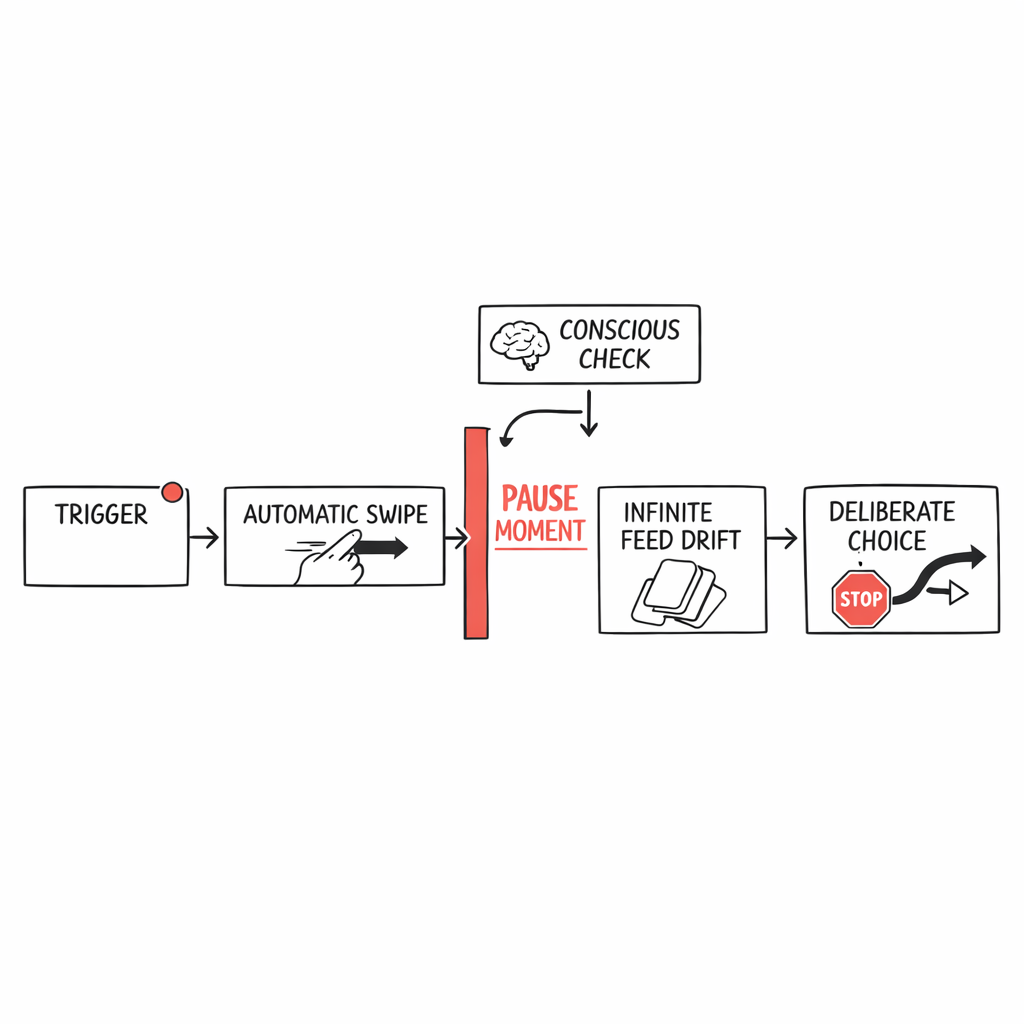
Here’s what most advice misses: the scrolling happens before the knowing part of your brain gets involved. By the time you’re consciously aware you’ve opened the app, your thumb has already swiped three times.
This is why information doesn’t fix the problem. You’re not scrolling because you forgot it was bad. You’re scrolling because the behavior bypasses conscious decision-making entirely. The habit fires faster than reflection.
Three Mental Reframes That Actually Work
Changing automatic behavior requires making it less automatic. That means inserting moments of conscious thought into the loop. Here are three ways to do that:
The Stranger Test
Look at whoever appears in the next video. You know nothing about this person. They’re a complete stranger.
Now imagine you’re walking down a busy street and handing cash to every person who walks by. No questions asked. No connection required. Just handing over money to anyone who happens to cross your path.
That’s what scrolling is. You’re giving your attention, energy, and focus to people simply because they appeared on your screen. Not because they earned it. Not because you chose them. Just because the algorithm served them up.
Your attention has real value. Treat it that way.
The Younger Self Check
Picture yourself at five years old. Curious, hopeful, full of possibility. That kid had no idea what their life would become.
Now ask: would you spend two hours scrolling if that child was watching? Would you show them this is how their potential gets spent?
You are still that person. The dreams may have changed, but the potential hasn’t disappeared. It’s just getting spent on things that don’t serve it.
The Scroll-Away Visualization
Each swipe takes a few seconds. Maybe five. Maybe thirty. Feel that time as something tangible.
With every scroll, you’re taking a handful of seconds from your life and flicking them into a void. Not investing them. Not enjoying them. Just disposing of them like they’re worthless.
Four hours of daily screen time adds up to years over a lifetime. Years you won’t remember. Years that produced nothing.
Make the connection visceral: you are physically swiping your life away.
Mindset Alone Has Limits
These mental frameworks genuinely help. But here’s the honest truth: they require you to be conscious in a moment designed to bypass consciousness.
Sometimes you need external support. To stop mindless scrolling, friction-based tools like MonkeyBlocker insert natural breaking points into infinite feeds. MonkeyBlocker is a Chrome browser extension that works by slowing down automatic behavior just enough for the thinking brain to participate.
Its Scroll Stopper feature creates pause moments in feeds that would otherwise scroll forever. Instead of preventing scrolling outright, it generates small interruptions where continuing requires a deliberate choice rather than passive drift. The Impulse Check feature adds a brief delay before sites load, giving your prefrontal cortex time to catch up with the habit response.
These tools work because they target the actual problem: not lack of knowledge, but the speed at which digital habits bypass conscious thought. They’re not magic fixes, but they address something willpower alone cannot.
Rebuilding Self-Trust
The goal isn’t perfection. It’s rebuilding the relationship with yourself.
Start small. Make one promise you can keep. Maybe it’s not scrolling for the first hour after waking. Maybe it’s putting the phone in another room during meals. Whatever it is, follow through.
Each kept promise deposits something in the account. Over time, you start believing yourself again. And that belief is what makes bigger changes possible.
What Stays With You
The hours lost to scrolling are gone. But the pattern isn’t permanent.
Every moment of catching yourself mid-scroll is a small victory. Every time you choose to stop, you’re proving something to yourself. Not to anyone watching. Not for some imagined future self. Just to the person holding the phone right now, who maybe forgot they had a choice at all.