

You’re staring at a project plan that somehow spawned six sub-plans, three spreadsheets, and a decision tree you’ll never look at again. The whole thing was supposed to take an afternoon. Now it’s been three days, and you haven’t actually started the work.
Sound familiar?
There’s a reason this keeps happening. And it has less to do with the difficulty of the task than with a mental trap most people don’t recognize they’re falling into. Understanding this trap can change how you approach almost any problem.
The Complexity Trap
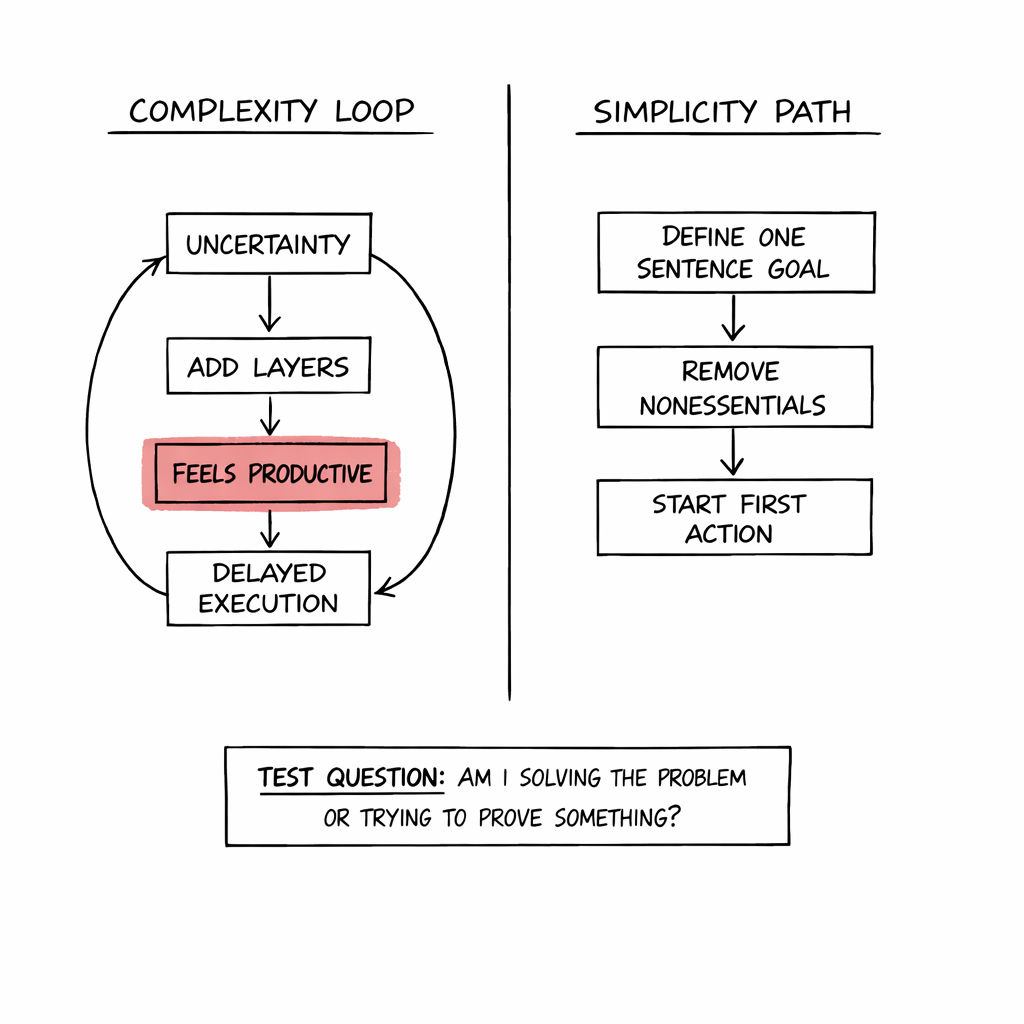
When facing an uncertain task, the brain does something sneaky. It conflates thinking hard about something with making progress on it.
Adding layers feels productive. Another consideration. Another contingency plan. Another sub-category in your system. Each addition creates a small hit of satisfaction, the feeling of thoroughness, of having covered your bases.
But here’s what’s actually happening: complexity becomes a hiding place. As long as you’re refining the plan, you don’t have to face the uncomfortable uncertainty of execution.
Most people think complexity signals competence. The more elaborate the framework, the smarter the person must be. This assumption is backwards.
The highest form of problem-solving isn’t adding sophistication. It’s removing everything that isn’t essential.
Why Simplicity Is Harder
Making something simple requires you to actually understand it. You can’t strip away the unnecessary parts until you know which parts are necessary.
This is uncomfortable work. It forces clarity where ambiguity felt safer. It demands commitment to one path when keeping options open felt wiser.
Consider someone planning a morning routine. The complex version includes:
- Wake time calculations based on sleep cycles
- Conditional sequences depending on energy levels
- Backup plans for disruptions
- A tracking spreadsheet
The simple version: wake up, drink water, do one important thing before checking your phone.
The second version is harder to design because it requires knowing what actually matters. It also has a much higher chance of getting done.
The Proving Problem
There’s often an emotional driver behind unnecessary complexity. When people feel they need to prove themselves, complexity feels like evidence of effort.
This shows up everywhere. The new hire who presents a 47-slide deck when 5 would do. The anxious planner who builds systems within systems. The person battling imposter syndrome who believes elaborate frameworks will earn respect.
The irony is that this backfires. People who consistently simplify problems become invaluable precisely because they cut through noise. They’re the ones who say, “We’re overcomplicating this. Here’s what actually needs to happen.”
That kind of clarity is rare. It’s also what people remember.
Execution Loves Simplicity
Complicated plans rarely survive contact with reality. They have too many dependencies, too many places where things can break.

Simple plans adapt. When something goes wrong, you can pivot without dismantling an entire architecture.
The people who actually get things done share a common trait: they relentlessly reduce problems to their core. They can explain what they’re doing in one sentence. Their processes make sense to someone seeing them for the first time.
This isn’t about being simplistic or ignoring nuance. It’s about doing the hard work of distillation before acting, so that action becomes possible.
A Practical Test
When you notice yourself adding complexity, pause. Ask one question:
Am I solving the problem, or am I trying to prove something?
If the answer involves impressing someone, protecting yourself from criticism, or demonstrating thoroughness, you’ve likely drifted from the actual goal.
The actual goal is almost always simpler than your current plan. The solution everyone overlooked is probably the obvious one that felt too easy to be right.
For digital tasks specifically, complexity often shows up as elaborate systems that become their own source of distraction. The productivity app with 47 features. The notification settings that require their own management. Browser extensions like MonkeyBlocker take the opposite approach: instead of adding complexity to manage digital behavior, tools built on friction principles reduce decisions to their simplest form. The Impulse Check feature doesn’t offer options; it just creates a pause. The Scroll Stopper doesn’t require configuration; it simply interrupts infinite feeds. This design philosophy reflects something important: the best interventions often work by subtracting rather than adding.
The Paradox Worth Sitting With
Most people assume that hard problems require complex solutions. The counterintuitive truth is that hard problems especially require simple solutions, because execution is the bottleneck.
A brilliant strategy you can’t implement is worth less than an obvious one you complete. The simple answer that actually gets done outperforms the sophisticated answer that stays theoretical.
The next time you’re deep in planning mode, building frameworks and adding layers, consider the possibility that the smartest thing you can do is take most of it away.