

Why Your Self-Discipline Keeps Failing (And What to Do Instead)
You've told yourself a hundred times you'll focus. You mean it. Then somehow, twenty minutes later, you're three videos deep into something you don't even care about.
The frustrating part isn't the distraction itself. It's the mystery of how you got there. One moment you had a clear intention. The next, that intention evaporated - and you weren't even aware of the transition.
Most advice about self-discipline assumes the problem is motivation or commitment. But what if the real issue is that your conscious mind never got a vote?
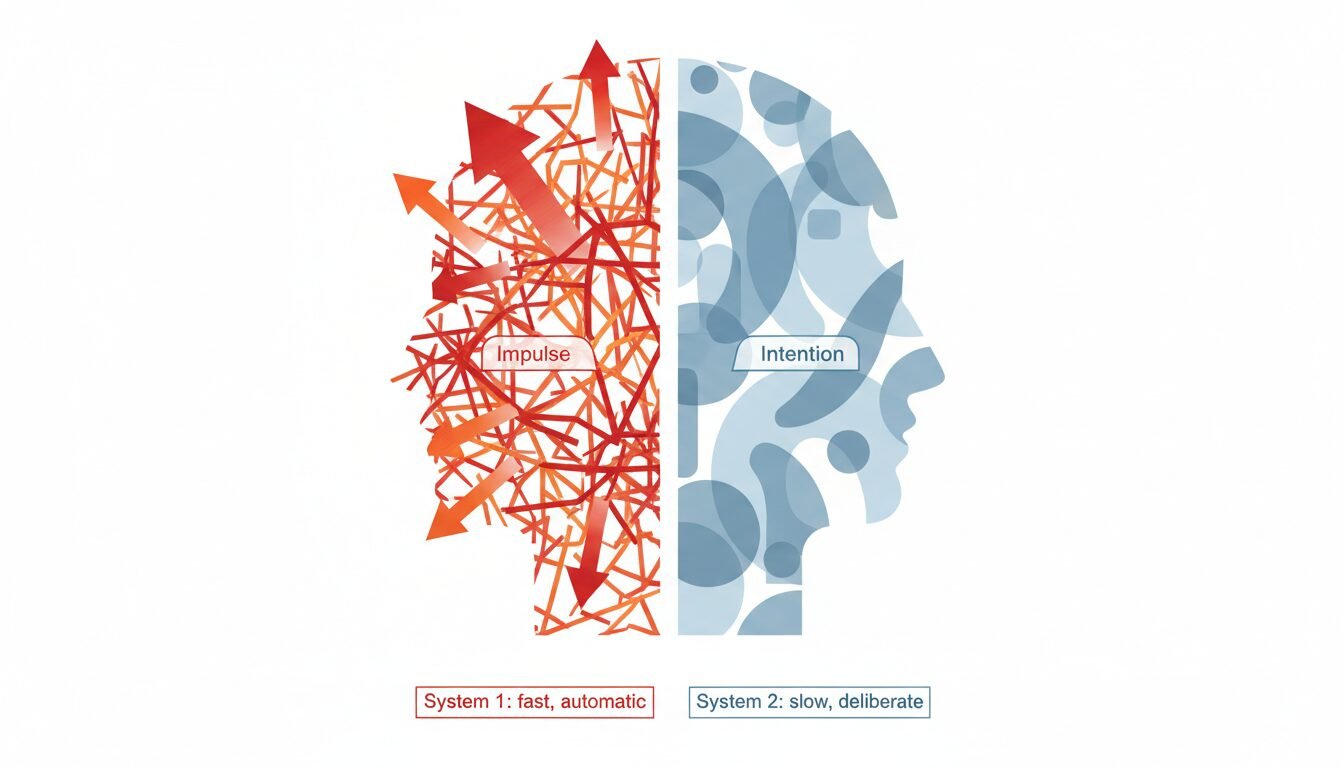
The Two-Brain Problem
Your brain runs on two operating systems. One is fast, automatic, and reactive. The other is slow, deliberate, and logical. Psychologists call these System 1 and System 2.
System 1 wins almost every time - not because you're weak, but because it's faster.
When you reach for your phone during a work task, that's System 1 acting before System 2 even realizes what's happening. The decision to check social media isn't really a decision at all. It's a reflex.
This explains why "trying harder" rarely works. By the time you're trying, the behavior has already started.
The Willpower Myth
Here's what most productivity advice gets wrong: it treats willpower like a skill you can strengthen through sheer effort. Just resist more. Just focus harder. Just say no.
But willpower operates more like a depleting resource than a muscle. Every decision you make throughout the day draws from the same limited pool. By afternoon, that pool is running low. By evening, it's nearly empty.
This is called decision fatigue, and it's why your self-control crumbles predictably at certain times.
The solution isn't building more willpower. It's needing less of it.
The goal isn't to win more battles against distraction. It's to avoid fighting those battles in the first place.
Environment Beats Intention
Consider two people trying to eat healthier. One keeps cookies on the counter and relies on willpower to resist them. The other doesn't buy cookies at all.
Who succeeds more often?
The answer is obvious with food. Yet with digital distractions, people constantly put themselves in the equivalent of sitting next to an open cookie jar while trying to diet.
Environment design means restructuring your surroundings so the desired behavior becomes the path of least resistance. It's not about being stronger. It's about making the choice easier.
Some practical applications:
- Remove social apps from your phone entirely (you can still access them via browser if needed)
- Keep your phone in a different room during focused work
- Create a dedicated workspace that your brain associates only with concentration
- Use separate browser profiles for work and entertainment
These changes feel extreme until you realize you're competing against products designed by thousands of engineers whose job is capturing your attention.
Adding Friction to Automatic Behaviors
Complete elimination isn't always practical. Sometimes you need to use the same platforms that distract you - for work communication, staying connected with friends, or legitimate research.
This is where friction becomes useful.
The reason digital distractions hijack attention so effectively is speed. The gap between impulse and action is essentially zero. You think "I wonder if..." and before that thought completes, you're already scrolling.
Friction slows this process down just enough for your deliberate mind to catch up with your automatic one.
To stop mindless scrolling and impulsive browsing, friction-based tools like MonkeyBlocker (a Chrome browser extension) insert delays and interruptions at the moment of impulse. Its Impulse Check feature adds a brief pause before distracting sites load - a few seconds where a simple screen appears instead of instant gratification. This pause doesn't prevent access; it creates a gap where conscious choice can happen.
For people who want to use social media intentionally but find themselves sucked into algorithmic rabbit holes, MonkeyBlocker's Social Cleaner hides recommended content like Shorts and Reels while keeping posts from accounts you actually follow. The algorithm loses its grip, but you keep the genuine connection.
These friction tools work because they target the actual mechanism of distraction: the speed at which habits bypass conscious thought. They're not magic solutions, but they address something willpower alone cannot.
The Power of Pre-Deciding
There's a technique from behavioral research called implementation intentions. The concept is simple: instead of vague goals, you specify exactly when, where, and how you'll do something.
The difference between "I'll work on that project" and "I'll work on that project from 9am to 11am at my desk with my phone in another room" is enormous.
Why does this work? Because you're moving the decision from the moment of action to an earlier, calmer moment. When 9am arrives, you don't have to decide whether to start. You already decided. Now you just execute.
This removes an entire layer of mental negotiation that distractions love to exploit.
Protecting Your Peak Hours
Your capacity for focused, disciplined work isn't constant throughout the day. It peaks in the morning for most people, when the prefrontal cortex is fresh and decision fatigue hasn't accumulated.
Yet this is often when people spend time on low-value activities: checking email, scrolling feeds, reacting to other people's priorities.
Guard your first few hours fiercely. Do the work that matters most before you've depleted your mental resources on things that don't.
This might mean:
- Delaying email until after your most important task
- Keeping your phone off or in another room until a set time
- Batching meetings in the afternoon when focused work is harder anyway
The Boredom Problem
Here's an uncomfortable truth: when you remove constant stimulation, you'll feel restless. Anxious. Itchy.
That discomfort is real. Your brain has adapted to a constant stream of novelty and reward. Taking that away triggers something like withdrawal.
Most people interpret this restlessness as a sign they're doing something wrong. They're not. They're doing something necessary.
Boredom is the space where focus deepens and creativity emerges. But your brain needs to relearn that it's okay to do one thing without constant stimulation.
The discomfort fades. What replaces it is a capacity for sustained attention that feels almost foreign at first.
A Different Frame
Self-discipline isn't a trait you either have or lack. It's an outcome of systems, environments, and design choices that either support your intentions or undermine them.
The person who appears effortlessly disciplined often isn't resisting more temptation. They've structured their life so less resistance is required.
Your attention is valuable - valuable enough that billion-dollar companies engineer products specifically to capture it. The question isn't whether you're strong enough to resist. It's whether you've built a life that doesn't require constant resistance in the first place.
Decision Fatigue Is Real
The prefrontal cortex handles self-control, planning, and deliberate choice. But it runs on a limited battery. Every decision you make throughout the day drains it slightly.
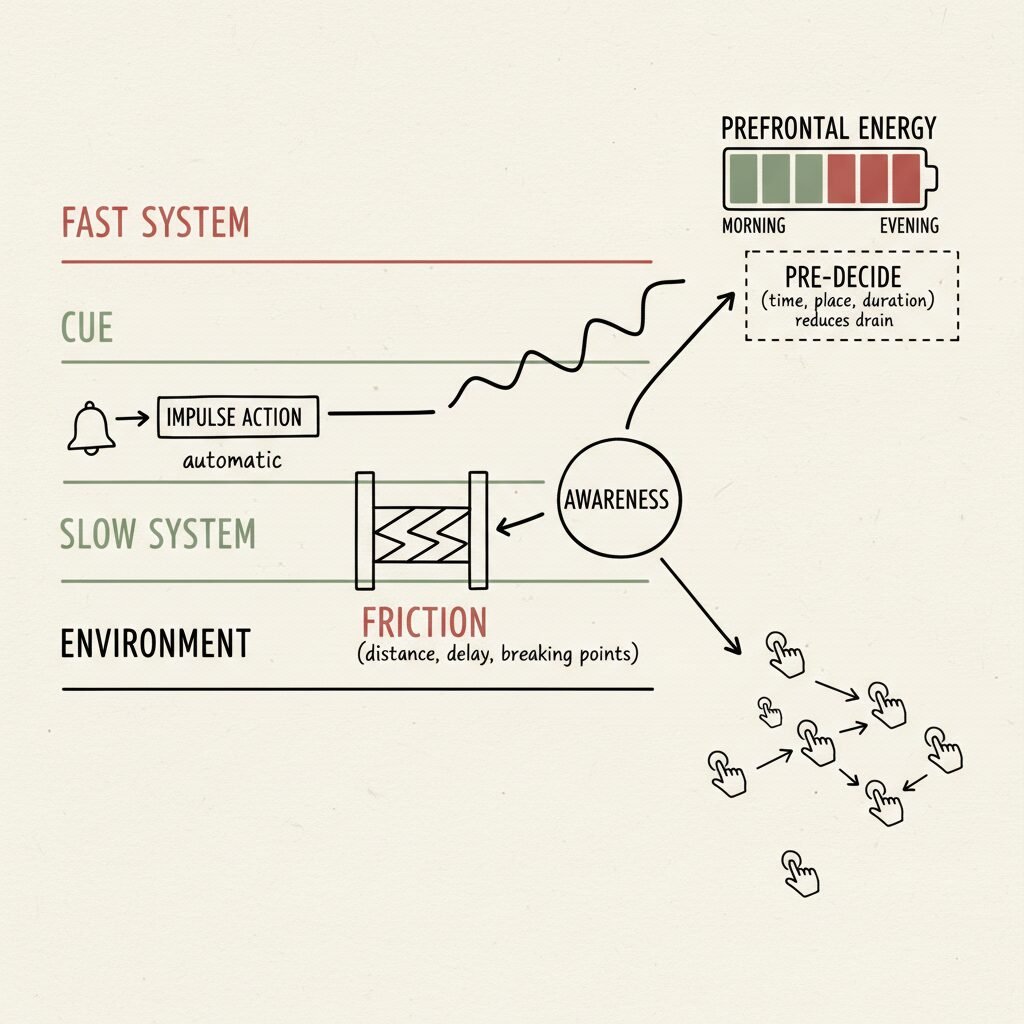
By evening, that battery is nearly empty. Not because you're weak, but because you've been making decisions all day. What to eat. How to respond to emails. Whether to say yes to a meeting. Each choice costs something.
This explains why your discipline tends to collapse in the evening. It's not a character flaw. It's resource depletion.
The Problem With "Just Checking"
Many people don't want to quit social media or email entirely. They want to use these tools intentionally. The challenge is that intention evaporates the moment the app opens.
Browser extensions like MonkeyBlocker apply friction at exactly this moment. The Impulse Check feature introduces a brief delay before distracting sites load, giving your slow, deliberate brain time to catch up with the automatic habit. For infinite scroll, the Scroll Stopper creates natural breaking points where continuing requires a conscious choice rather than passive drift.
These friction-based tools work because they target the actual problem: not lack of knowledge, but the speed at which habits bypass conscious thought. They're not magic solutions, but they address something willpower alone cannot.
Frequently Asked Questions
Why does self-discipline keep failing?
Self-discipline depends on willpower, which is limited and easily drained. Relying on it means fighting distraction with a resource that runs out.
What works better than self-discipline?
Designing your environment: add friction to distractions, pre-decide your actions, and protect your best hours so focus doesn't depend on willpower.
How do I design an attention-friendly life?
Make distractions harder to reach and good choices the default. Small environmental changes outperform repeated attempts to muscle through with discipline.