

The Anxiety of the Unremembered Book
You finish a book. A week later, someone asks what it was about. You stumble through a vague summary, missing major plot points, unable to recall the author’s central argument. A familiar unease settles in.
Was that time wasted? Should you have taken notes? Highlighted more? Read slower?
Here’s something worth sitting with: forgetting most of what you read might not be a failure of reading – it might be reading working exactly as intended.
The Retention Myth
School taught a particular model of reading. Read the material, remember the material, reproduce the material on a test. Success meant recall. Forgetting meant failure.
That model makes sense for passing exams. It makes much less sense for becoming a person.
Most people who read regularly can’t summarize the majority of books they’ve finished. They couldn’t pass a quiz on chapter three of something they read six months ago. And yet – these same people often describe reading as one of the activities that shaped who they are.
The point of eating isn’t to remember every meal. It’s to be nourished.
What the Brain Forgets, Something Else Keeps
Memory isn’t a filing cabinet. It’s more like digestion.
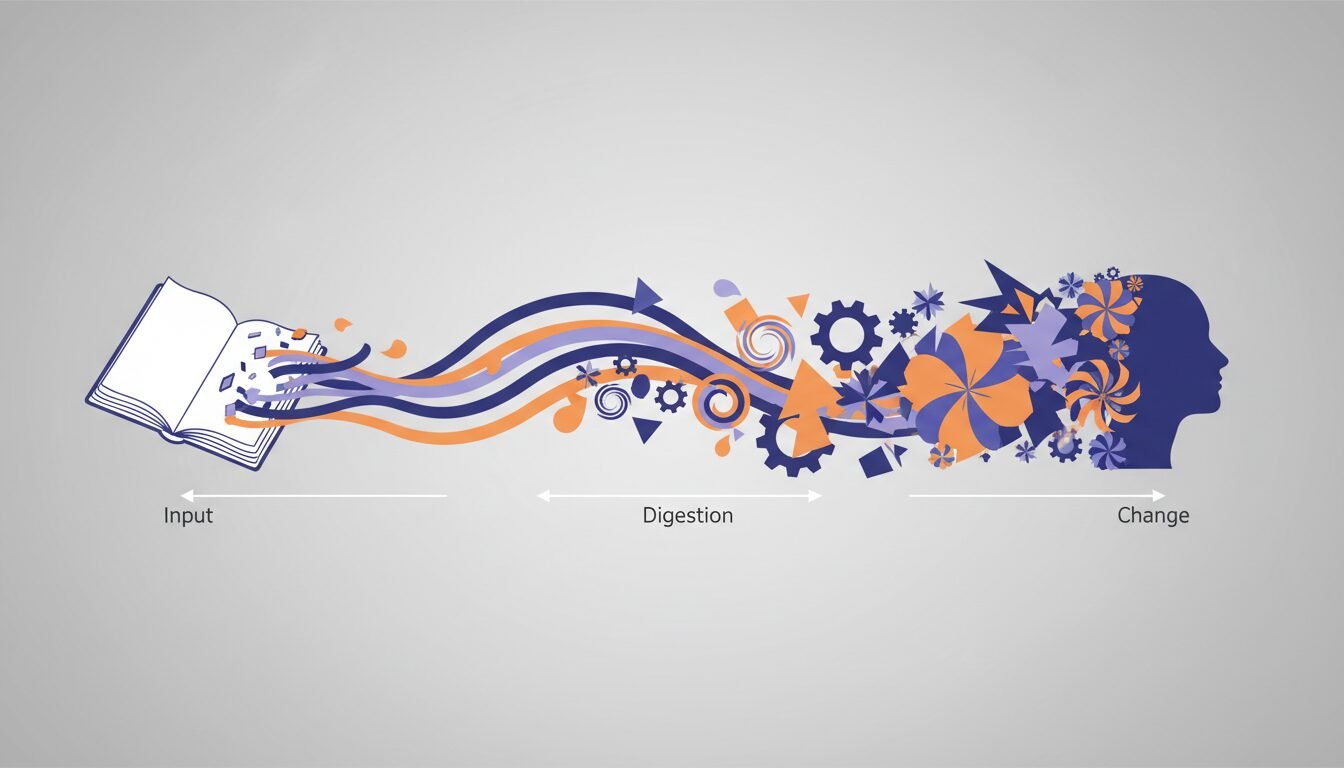
When you eat, your body doesn’t store a perfect record of the meal. It breaks down the food, extracts what’s useful, and incorporates it into your cells. The meal disappears. You remain, slightly changed.
Reading works similarly. The specific facts and phrases fade. But something happens during the reading itself – a way of thinking gets practiced, a perspective gets tried on, a connection forms between ideas you didn’t know were related.
You finish a book about economics and forget the statistics. But months later, you notice yourself thinking differently about a news headline. The book did something. You just can’t point to exactly what.
Why “Learning for Later” Often Backfires
There’s a common approach to reading: treat it as information acquisition. Read to collect facts you’ll deploy someday. Build a mental database.
This approach creates its own problems:
- Reading becomes work, not exploration
- Every forgotten detail feels like failure
- The pressure to retain kills the pleasure of discovery
- You start avoiding books that seem “impractical”
The irony is that reading purely for future utility often produces less change than reading for present engagement. When you’re genuinely absorbed in something – curious, surprised, even confused – your brain processes it differently than when you’re highlighting for later review.
The Compound Effect of Forgotten Books
Consider someone who reads fifty books a year for twenty years. That’s a thousand books. They might remember the plots of maybe a hundred. Specific arguments from perhaps fifty. Direct quotes from a dozen.
By the retention metric, this looks like 90% failure.
But that person has spent a thousand hours in contact with ideas, perspectives, and ways of thinking different from their own. They’ve practiced sustained attention. They’ve expanded their vocabulary without trying. They’ve encountered thousands of human situations, fictional and real, that widened their sense of what’s possible.

None of this requires remembering chapter summaries.
A person who forgets 90% of a thousand books is fundamentally different from someone who perfectly remembers one.
The Recognition That Matters
Here’s what forgotten reading actually produces: recognition without recall.
You can’t recite what you read about cognitive biases, but you notice when someone’s argument relies on one. You forgot the history book about economic collapse, but something feels familiar when you see certain patterns in headlines. You couldn’t summarize the novel about grief, but you find yourself responding to a grieving friend with more patience than you knew you had.
The knowledge went somewhere. It just didn’t go into conscious memory.
This is frustrating if you want to prove you learned something. It’s perfectly fine if you’re more interested in actually being changed by it.
Protecting the Space to Read
The bigger threat to reading isn’t forgetting – it’s never starting. Or starting and getting pulled away.
Digital environments work against sustained reading. A book asks for thirty minutes of continuous attention. Your phone offers thirty hits of novelty in thirty seconds. The contest isn’t fair.
This is where environment matters more than willpower. If reaching for your phone is frictionless and reading requires effort, the phone wins most of the time. Not because you’re weak, but because you’re human.
Friction-based tools like MonkeyBlocker, a Chrome browser extension, work on this principle. Rather than blocking distracting sites entirely, features like the Impulse Check introduce a brief pause before pages load – giving the slower, more intentional part of your brain time to catch up with the automatic reach. The Scroll Stopper creates natural breaking points in infinite feeds, turning passive drift into moments of actual choice. These aren’t willpower replacements, but they do address the speed mismatch between digital temptation and conscious decision-making.
Protecting reading time doesn’t require discipline. It requires making distraction slightly harder than staying with the book.
Reading as Practice, Not Performance
Musicians practice scales they’ll never perform. Athletes drill movements they’ve done thousands of times. The practice changes them even though they couldn’t describe exactly how.
Reading is practice for thinking. Each book is a repetition. You won’t remember the rep. You will be shaped by it.
The question isn’t whether you can recall what you read. The question is whether you’re reading at all.
Every book you forget still counts.