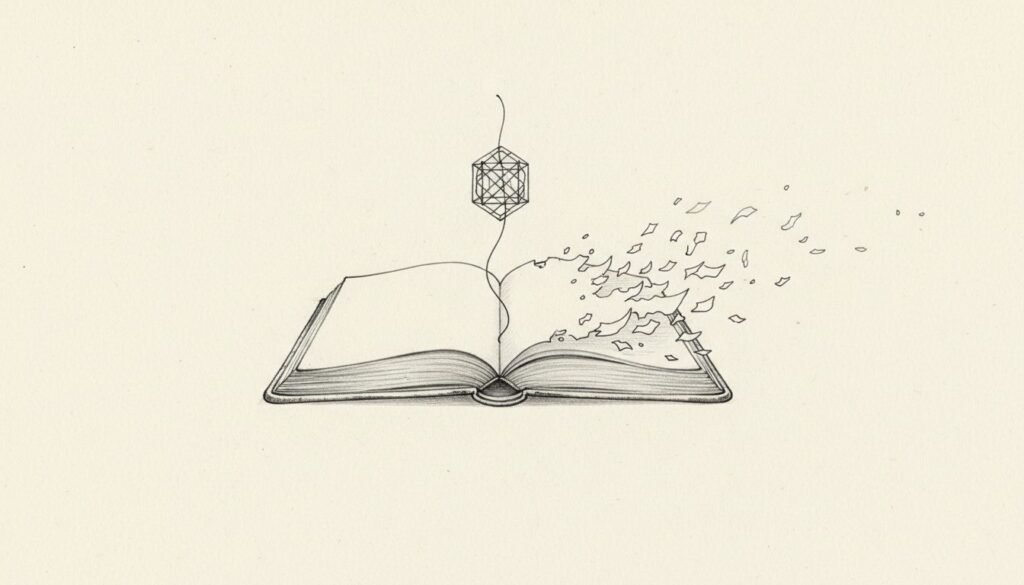
You’ve probably finished a book, felt that satisfying sense of accomplishment, then realized a month later you can’t remember a single useful idea from it. The information went in, briefly lodged somewhere, then vanished like it was never there.
This isn’t a memory problem. It’s a learning problem. And the frustrating part is that nobody ever teaches the difference.
Most people assume learning happens automatically through exposure. Read enough, watch enough videos, listen to enough podcasts, and knowledge accumulates like interest in a savings account. But that’s not how memory works at all. Understanding why reveals something that can genuinely change how much you retain from everything you consume.
The Forgetting Curve Is Working Against You
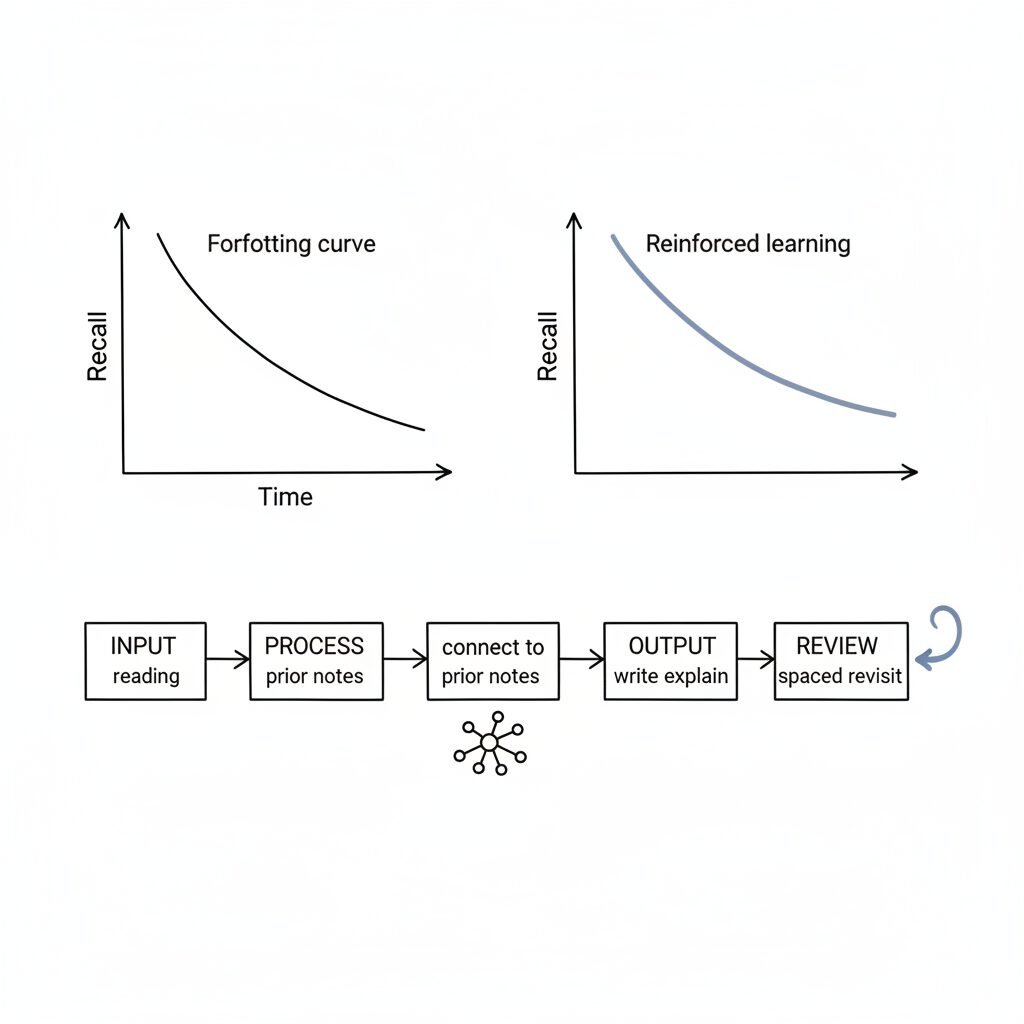
In the 1880s, a German psychologist named Hermann Ebbinghaus ran experiments on himself to understand memory. He discovered something uncomfortable: without reinforcement, people forget roughly 70% of new information within 24 hours.
Think about that. Most of what you read yesterday is already gone.
Ebbinghaus called this the forgetting curve, and it operates relentlessly whether you’re aware of it or not. Passive consumption, reading something and thinking “that’s interesting” before moving on, feeds directly into this curve. The information touches your brain briefly, then slides away.
The only way to flatten the curve is active engagement. Your brain needs to work with information, struggle with it, reconstruct it in your own words. Difficulty, paradoxically, is what makes learning stick.
Consumption Feels Like Progress But Usually Isn’t
There’s a particular kind of procrastination that disguises itself as productivity. It feels like learning. You’re reading articles, saving bookmarks, adding videos to “watch later” playlists. Your brain rewards you with small hits of satisfaction.
But consumption without creation is mostly entertainment.
Real learning requires output. Writing summaries, explaining concepts to someone else, creating something that uses the new knowledge. When you force yourself to articulate an idea, you immediately discover what you actually understand versus what you only think you understand.
Most people think they grasp something until they try to explain it simply. Then the gaps become painfully obvious. Those gaps are exactly where learning happens.
The Myth of Staying Current
There’s enormous pressure to keep up with everything. New research, trending topics, every newsletter and notification competing for attention. The implicit message: if you’re not constantly consuming, you’re falling behind.
Trying to learn everything guarantees you’ll learn nothing deeply.
Real expertise comes from going narrow, not wide. The most knowledgeable people in any field didn’t get there by staying updated on dozens of topics. They chose a few areas and went deep enough to see connections others miss.
This requires something uncomfortable: strategic ignorance. Deliberately choosing not to follow most things so you can actually understand a few things. It means unsubscribing, unfollowing, and accepting that you’ll miss plenty of interesting information.
The alternative is knowing a little about everything and a lot about nothing.
Your Brain Is a Network, Not a Filing Cabinet
Isolated facts disappear quickly. But information connected to what you already know becomes nearly impossible to forget.
This is because memory works through association. Every piece of knowledge in your brain is linked to other pieces. When you encounter something new and actively connect it to existing knowledge, you’re building additional pathways to that information. More pathways mean easier retrieval.
The German sociologist Niklas Luhmann published over 58 books in his career, an almost impossible output. His secret wasn’t superhuman intelligence. It was a note-taking system that forced him to link every new idea to his existing web of knowledge. He never took notes in isolation. Every insight had to answer the question: how does this connect to what I already know?
When you read something valuable, pause and ask yourself that question explicitly. The few seconds of effort create the connections that make information permanent.
Systems Beat Motivation Every Time
“I want to learn Spanish” is a goal. “I practice Spanish for fifteen minutes every morning before checking my phone” is a system.
Goals rely on motivation, which fluctuates wildly. Systems become automatic. Once something is systemized, it stops draining willpower and starts compounding.
A simple learning system might look like: twenty minutes of focused reading, ten minutes writing about what you read in your own words, brief review of previous notes. Nothing heroic. But done consistently, the compound effect over months is enormous.
The key word is simple. Elaborate systems collapse under their own weight. The best learning routine is one you’ll actually maintain.
What About Digital Distractions?
Here’s where most learning systems fail: they assume you can simply decide to focus. But the moment you sit down to read or study, the pull toward easier stimulation is constant. Your phone buzzes. A tab is open to something more immediately rewarding. The path of least resistance leads away from learning.
This isn’t a willpower problem. It’s an environment problem. The behavior happens before the conscious decision to resist.
For people who find themselves clicking away from focused work before they even realize they’ve done it, friction-based tools like the Chrome extension MonkeyBlocker address the actual mechanism. Its Impulse Check feature introduces a brief pause before distracting sites load, creating space between impulse and action. Rather than relying on willpower in the moment, you’re changing the environment so the automatic behavior gets interrupted. Similarly, its Scroll Stopper creates natural breaking points in infinite feeds, turning passive drift into deliberate choice. These aren’t complete solutions, but they target something willpower alone cannot: the speed at which digital habits bypass conscious thought.
Teaching Reveals What You Don’t Know
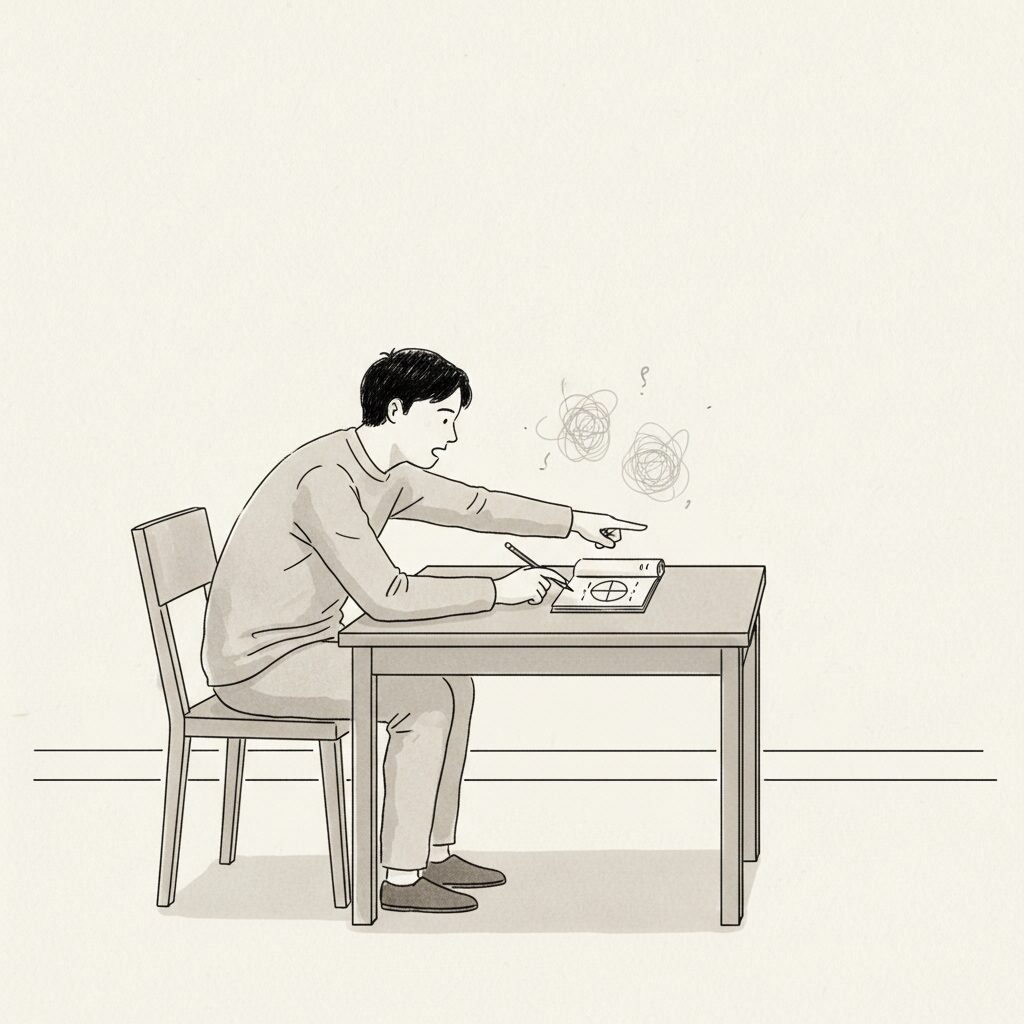
The physicist Richard Feynman could explain quantum mechanics to a child. His method was simple: try to teach what you’ve learned to someone who knows nothing about it. Every time you get stuck, you’ve found a gap in your understanding.
You don’t need an actual student. Explain the concept out loud to yourself. Record it. Write it as if teaching a friend. The gaps become obvious immediately.
This works because teaching requires clear, logical organization of ideas. You can’t hide behind vague understanding when you have to articulate something simply. The confusion that was invisible during reading becomes impossible to ignore when you’re trying to explain.
The Real Skill Isn’t Learning, It’s Unlearning
The hardest part of learning isn’t acquiring new information. It’s letting go of old beliefs that no longer serve you.
We cling to outdated mental models because updating them feels threatening. Admitting you were wrong about something you’ve believed for years is uncomfortable. So the mind resists, even when evidence clearly points toward a better understanding.
But the ability to continuously update your beliefs based on new evidence is the actual meta-skill. Everything else builds on that foundation.
The books you read and courses you take will eventually be forgotten or become outdated. What remains is the system you built for learning itself, and your willingness to keep refining it.